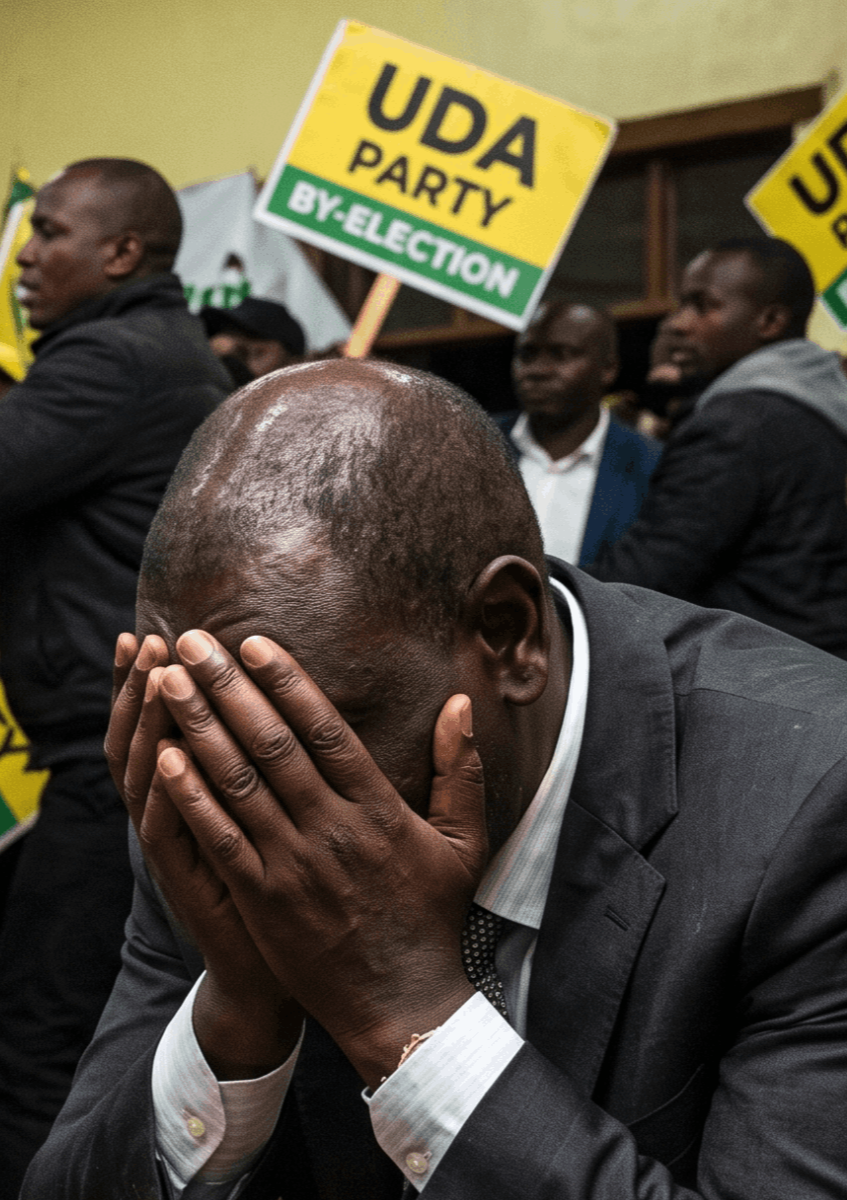
BLANKETS, CASH, COOKING GAS, ELECTRICITY POLES, MATTRESSES, SHOES & SPEEDBOATS: HOW AN UNWAVERING VOTER SPURNED STATE LARGESSE IN THE JUST CONCLUDED OL KALOU BY-ELECTION AND DEALT A DEVASTATING BLOW TO RUTO’S UDA PARTY
In the aftermath of the just concluded Ol Kalou by-election on July 16, 2026, three things happened: The Jubilee Party deputy organising secretary resigned and crossed over to a competing opposition outfit. The Kikuyu ethnic community was likened to a hyena by a Cabinet Secretary close to President William Ruto. Some of the Deputy President’s important powers of coordinating inter-governmental agencies were clipped and apparently donated to the office of the Prime Cabinet Secretary. These changes took place within the first 10 days of the ruling party United Democratic Alliance (UDA) being vanquished in a fight that had assumed biblical proportions – David vs Goliath. Were these changes related or coincidental? It is question we shall return to in a jiffy.
Yellow fever infection
The Kenya Kwanza coalition government pulled out all stops to ensure it captured the coveted constituency seat that had been left vacant after the MP David Njuguna Kiaraho’s sudden death on March 29, 2026. The late MP had won the seat on a Jubilee Party ticket on August 9, 2022. Yet, the battle for the seat became a fierce contest between UDA and the impeached Deputy President Rigathi Gachagua’s Democracy for Citizens Party (DCP). A fledgling party, DCP was formed on May 15, 2025 and was out to prove that it was the newest kid on the block and now angling to be the sole political vehicle for the Mt Kenya region. Former President Uhuru Keyatta’s Jubilee Party, which had performed dismally in the 2022 presidential elections, especially in its backyard, has been struggling to stay afloat: In the lead-up to the 2022 general election, the Mt Kenya region had caught “Yellow fever” infecting all the “red blood cells.” The UDA colour is yellow, while Jubilee’s red.
Devastating blow
A year to the general election on August 10, 2027, President Ruto’s UDA, in Ol Kalou, was fighting to prove that it still had a stranglehold on the populous Mt Kenya region, a region that had propelled Ruto to State House. Of the 7.1 million votes that Ruto got, an upward of 3.5 million were from the Mt Kenya region. Ruto’s Mt Kenya support base has been slipping, after the region turned its back on him, barely two years after the region had overwhelmingly given him the stamp of approval. With the culmination of the Gen Zs’ zeitgeist on June 2024, a generational protest that shook Ruto’s nascent government, the Mt Kenya people bade its final bye to Ruto’s regime. The Ol Kalou by-election cleared all reasonable doubts that Ruto had any meaningful support left in the Mt Kenya region: It was a shattering blow to Ruto, as he seeks re-election in a year’s time without the backing of the region that he has revisited countless times since assuming office and increasing the tempo, after the region signalled its dissent towards him.
Uhuru’s handmaiden
One of the most glaringly message that came from the Ol Kalou by-election is the death knell of the Jubilee Party. The by-election had nine competing candidates. The Jubilee Party had fielded a candidate whose name nobody cared to remember. Wilson Kigwa, got 198 votes – this wasn’t a defeat – it was an obliteration. The voter had spoken and in not so many words, had pronounced himself on matters Jubilee Party in Mt Kenya region; It was good while it lasted. On July 21, 2026, Pauline Njoroge, the deputy organizing secretary resigned with immediate effect and effectively joined the Linda Mwananchi movement – a remnant of the ODM split, a brutal consequence of the aftermath of Raila Odinga’s death on October 15, 2025. Njoroge, in Jubilee Party, was Uhuru’s handmaiden. She’ll continue being Uhuru’s protégé in Linda Mwananchi movement where she was immediately designated as the communications liaison officer.
The ugly hyena
The Ol Kalou by-election was between DCP’s Sammy Douglas Kamau Waweru and UDA’s Samuel Muchina. Kamau Waweru faced the wrath of the government machinery; the UDA campaign brigade involved nine cabinet secretaries, 10 principal secretaries 91 MPs and 35 heads of parastatals. Ruto was not pulling no punches: This was personal, he had to win the seat; by hook or crook. He tasked his brigade to descend on the ground and deliver what could be delivered – from blankets to mattresses, from cooking gas to electricity poles and from shoes to speedboats – Ruto was on a mission to capture Ol Kalou. After allegedly spending a whooping Sh16 billion in development projects and cash handouts, his UDA candidate garnered a paltry 5,450 votes against Kamau’s 35,440 votes. This wasn’t a contest, it was a disaster; Ruto had been vanquished and the message had been painted on the wall, from now on, Mt Kenya region had gone green. Green is the DCP’s colour. On the same day that Jubilee’s Pauline Njoroge resigned, Cabinet Secretary for Health Aden Duale in Mandera County, made the disparaging remark, likening ethnic Kikuyus to hyenas. In the fables that we read as children, it wasn’t lost on us that a hyena’s characteristics included being deceitful, greedy, a scavenger and very ugly.
A vote for the urchin
The Ol Kalou debacle had hit hard among the UDA top mandarins. How dare the voter? Even after being dazzled by helicopters crisscrossing the Ol Kalou airspace as if for airshow, even after being brought uncanvassed goodies, even after being handed Sh5,000 to help him wake up to vote on the morning of the by-election, the voter had decidedly opted for his choice, an underdog who had been called an urchin by one of Ruto’s chief campaigners, the cantankerous Moses Kuria. We’ll vote for our urchin; you can keep your well-suited candidate. Yet, that wasn’t even the worst of the impetuous insults the Ol Kalou voter had to bear: A deep and demeaning insult by one of the top government mandarins referred to them as harlots. The Kikuyus love money so much (like harlots), we’ll bribe them to high heavens (with money) and they’ll do our biddings. Did the refusal to vote for the Ruto candidate, even after being demeaned and insulted, elicit unwarranted anger, bitterness and callousness from the UDA hawkish brigade? The hyena tag was supposed to be the ultimate insult on a community that had refused to be seduced by state largesse that would have affirmed the UDA’s top honchos’ stereotype of the Kikuyu voter.
The taming of the shrew
As the Kikuyu ethnic community was being branded the ugly hyena, the Deputy President Prof Kindiki Kithure suddenly found himself on the defensive, rationalizing his DP position to all who cared to listen. Just like his boss, he hadn’t dared step in Ol Kalou. They knew what was awaiting them. A couple of months ago, he had frothed on how UDA would teach Gachagua a lesson in the Ol Kalou by-election. On July 27, Ruto quietly trimmed some of his essential powers and handed them to Musalia Mudavadi, the Prime Cabinet Secretary, his nemesis in the Kenya Kwanza Coalition. Is the trimming of some of Kindiki’s duties a sign of what will befall him in the not-so-distant future? It’s a well-trodden path that Ruto has had to tread himself: President Uhuru in his second term, clipped some of Deputy President’s Ruto’s powers and transferred them to CS for Interior, Fred Matiang’i, who for all practical purposes, acted as the de facto Prime Minister. The difference is, Ruto had already crossed over into the second term with Uhuru. The worst that could happen to him was impeachment. Uhuru wavered and let Ruto ran his course. The taming of the shrew by Ruto hints at a deputy walking on egg shells in his first term. A year to the general election, will Prof Kindiki be retained as a running mate?
Pyrrhic victory
At a glance the Ol Kalou by-election is a microcosm of the August 2027 elections, a harbinger of how the UDA will be pulverized in the Mt Kenya region – and possibly the rest of the country. In the last three months they were other by-elections – nine of them: Banisa, Baringo, Emurua Dikiir, Isiolo South, Kasipul, Malava, Magarini, Mbeere North and Ugunja. Why would the Ol Kalou by-election elicit so much attention from the ruling party UDA? The other by-election that nearly attracted the same clamour was the Mbeere North, a tiny constituency also from the Mt Kenya area. In the Mbeere North by-election, the state allegedly spent Sh500 million bribing the voters. It was critical that the ruling party UDA wins the seat. They did, by a mere 494 votes. The seat fell vacant after the Democratic Party (DP) MP was appointed a CS. Big on optics (and short on promises), Ruto orchestrated the by-election to prove he had a foothold on the treacherous Mountain. With the pyrrhic victory in Mbeere North, Ruto and UDA mandarins beat their cheats and believed they would repeat their shenanigans in Ol Kalou.
Ruto’s Waterloo
The UDA party barons’ palpable acrimony and invectives directed at the ethnic Kikuyus post-Ol Kalou by-election is a consequence of difficult truths gleaned over time and hard to hide: In the hearts of their hearts, they recognize several invariable factors proven since the advent of the return to multiparty elections in 1992: It is the Kikuyu voter who makes and breaks a presidential candidate. It is the Kikuyu voter who sets the pace, tone and rhythm of presidential campaigns. Inevitably, other ethnic communities look up to the Kikuyu voter to gauge the suitability and veracity of a presidential candidate. In other words, is the candidate beatable or not? It follows therefore that if the Kikuyu voter rejects a presidential candidate, what are the chances that the rejection fever might catch and spread to the rest of the other ethnic communities? By burying the UDA candidate, the Ol Kalou voter’s direct message to Ruto was poignant – this is what awaits you in 2027; a Waterloo in Mt Kenya region. Corollary, what the Ol Kalou voter also did was to level up campaign politics. That is why the by-election became the most expensive in post-independent Kenya. Today, the Kikuyu vote is the most canvassed, the most sought after and the most valuable. At no time in the history of Kenya has the vote of a Kikuyu meant so much for a ruling party. Hence, the Ol Kalou by-election became a watershed moment for election campaigns going forward: Dish out the goodies if you must, but be informed, we’ll vote with our feet and conscience. Take it or leave it.
The purveyors of Kenya’s political history will tell you that Ol Kalou constituency is one of a kind: They’ll also tell you that the more things change, the more they remain the same. That the lessons of history is that there are no lessons to be learned from history. And, that history doesn’t repeat itself, events do.
JM Kariuki
The original larger Ol Kalou constituency, then referred to as Nyandarua North constituency was created after 1963, when Kenya gained independence and is located in Nyandarua county. It is populated by migrant Kikuyus especially from Nyeri county, although there are also as many Kikuyus from Kiambu and Murang’a counties. It is largely composed of settlement schemes that settled landless Kikuyus hoping to find succour in a new farmable territory, not too faraway from their ancestral homes. A resilient lot, with a history of resistance, their most famous MP was Josiah Mwangi Kariuki, a multimillionaire MP who was the darling of his electorate. In the 1974 general election, the Jomo Kenyatta regime with the connivance of the powerful Kiambu Mafia marooned JM Kariuki in his home in Gilgil and barred him from campaigning for his MP seat. He wasn’t even allowed to plaster his posters anywhere. When the results were announced, he had trounced his opponent by an avalanche of votes. The Ol Kalou voter had spoken. JM was voted as he sat in his house watching TV. On March 2, 1975 he was found murdered in the infamous Ngong forest.
Patronage politics
The present day Ol Kalou is split into three constituencies – Kipipiri, Ol Kalou and Ol Jororok. In 1995, three years after President Moi reluctantly accepted multiparty politics, the opposition Ford Asili Kipipiri MP Muchemi Ngatia dropped dead. Moi, just like Ruto, desperate to prove to all and sundry that he had a grip on the most populous community in the country, seized the opportunity to show case his masterly of politics of brinkmanship in the hostile environs of Central Kenya. In the 1992 December general election, the ethnic Kikuyu had spurned Moi’s Kanu party and voted largely for the opposition parties of Mwai Kibaki’s DP and Kenneth Stanley Njindo Matiba’s Ford Asili. In the heydays of Kanu’s monolithic rule Moi used development as a weapon of reward and punishment to “opposition” areas. He dished out development like marshmallow to abiding children. It was patronage politics and politics of development and favouritism at best: He dangled the carrot of development and used the stick to withhold it. In the lead-up to the September 4, 1995 by-election, Moi asked the Kenya Power and Lighting Company (KPLC) to send electricity poles down to Kipipiri to connect power to the existing electricity pylons. Road graders were rolled down to level up the murram roads. To cap it all, the electorate was relentlessly bribed with unending cash. The contest was between Kanu’s Joe Maina vs DP’s Mwangi Githiomi. But as we are all aware, Maina and Githiomi were mere pawns in a sub-plot of a vicious elite battle. The real fight was between Moi and his former Vice President Kibaki. When the results were announced, Githiomi had walloped Maina by 14,858 to 3144. It was an absolute humiliation for Moi who had campaigned for Maina four times and had camped at a place called Mawingo.
Cultural Taboo
Wanjiku Muhia, of the neighbouring Kipipiri MP, one of the chief campaigners for the DCP’s candidate Kamau reminded the older Ol Kalou generation of the recalcitrant spirit of the 1995 electorate that sent Moi packing. As she campaigned across Ol Kalou, she reminded the DCP crowds that no amount of cash, blankets, gas cylinders, the hauling of a locomotive engine with a couple of cabins and the presence of electricity poles ought to dissuade them: We’ve been here before; Moi descended on Kipipri 31 years ago threatening to overwhelm us with development. He was told you can keep your development, we’re just fine; we’ll vote for whomever we deem fit. Thirty-one years later, Ruto who should have taken a leaf from the Kipipiri debacle, instead, doubled down on the politics of patronage and development, post-2010 new constitution. The flooding of goodies became suspect and counter-productive. Why for example, the electorate posed would the government provide us with hospital mattresses? Word quickly spread that it was a cultural taboo to sleep on a mattress meant for a sick patient. Wanjiku asked the people to take the mattresses to the Ol Kalou hospital.
You can rent a Kikuyu, but you cannot buy one
It is possible that the Ol Kalou by-election is the last one before the August, 2027 presidential election. After the UDA party was dealt a devastating blow, some of the UDA allied MPs from Mt Kenya region called for a meeting and said they would be issuing a way forward insofar as their politics was concerned. They have no choice but to calibrate their politics, how they will do that is a matter of conjecture. During the three-month campaign, the UDA party yellow colour was frowned upon. The party’s regalia was worn because the people needed to collect the goodies. On the eve of the by-election, they were trashed. Ruto and his cohorts had grossly underestimated the intelligence of the Ol Kalou voter. The maverick Mutahi Ngunyi of the tyranny of numbers fame and master of epithets and soundbites once warned competing political elites that you can rent a Kikuyu, but you cannot buy one.